Rivers
A river is a stream of water that flows over land. It is vital for people, plants and animals. Rivers offer routes for the transportation of people and goods. A river’s water shapes landscapes and produces electricity.
Parts of a River
Rivers usually begin high up in the mountains as a tiny flow of water that comes from rainfall or melting ice. Sometimes rivers originate in a lake or a layer of groundwater that comes up to the surface as a spring.
Rivers consist of three sections.
Upper Course
The upper course is the beginning of a river. It is also referred to as a stream. In this section, it is very small and transports very little water, which flows quickly down a steep hillside. As it moves downward, a stream gets bigger. Other streams, called tributaries, flow into it.
When streams carry more and more water they grow into rivers. They cut their way through landscapes and change the face of the earth. Erosion is caused by the flowing water that cuts into bedrock and makes a river’s bed deeper. Waterfalls, canyons and other landforms are typical of the upper course of rivers. Rivers transport rocks of different sizes and deposit them as they move along.
Middle Course
During the middle course, a river gets flatter. Water moves at a slower pace. This section of a river cannot transport very big rocks anymore; instead, soil, gravel, sand and silt sink to the bottom of the river. More and more material is deposited as sediments.
Lower Course
The lower course is the broadest part of a river. Huge masses of water flow slowly across flat plains. Such rivers do not transport any rocks with them; they deposit fine material and silt. As they wind their way towards the sea rivers start curving back and forth gently, creating meanders.
At its mouth, a river flows into the sea. Estuaries form in places where there are ocean tides. Rivers open themselves in triangular form to the vast ocean. Freshwater mixes with the salt water of the ocean. Deltas form in places where river water deposits sand and silt and gradually moves the coastline further into the sea. Many kilometers from the coast, rivers split up into several smaller rivers.
Many elements have influenced the form of rivers and valleys. Throughout the Ice Age, glaciers widened river valleys and shaped them as a U. In deserts, rivers dry up during certain months of the year when there is no rainfall. In karst regions, water trickles through cracks into the ground and rivers often flow under the surface.
River basins
A river basin consists of a main river and the tributaries that flow into it. Big river systems can have hundreds of tributaries and drain huge areas of land. The largest river basins are in the tropical rainforest. The Amazon River basin covers an area of almost 7 million square kilometers, about 40% of the South American continent. The Congo basin drains much of central Africa.
Every landmass on earth belongs to a watershed, the area that catches all the rain and leads it into rivers.
Rivers in history
Rivers have always played a dominant role in history. Many civilizations have been built along great rivers. Ancient Egypt developed along the Nile, Mesopotamia spread along the Euphrates and Tigris region. The Indus valley is among the oldest civilizations in history.
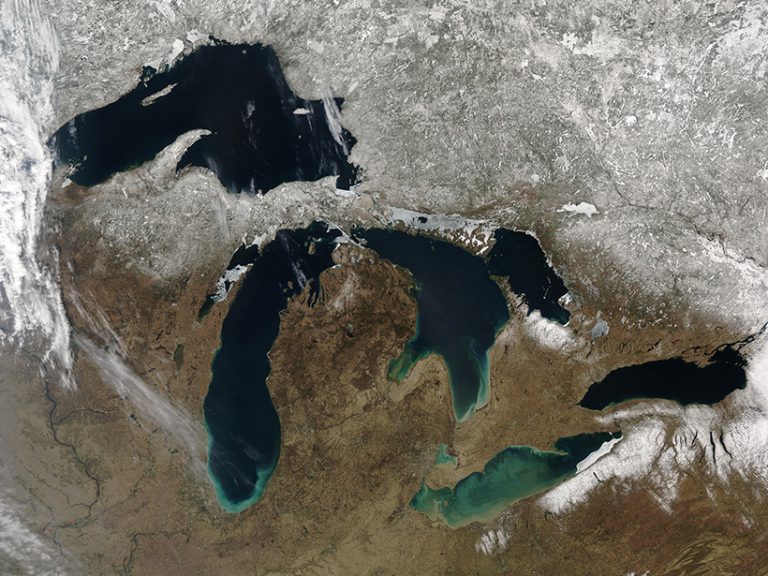
Rivers gave humans farmland to grow crops as well as a route to travel and trade their goods with other people. As time went on some rivers were turned into important waterways and used to transport goods to the inner parts of a continent. The St. Lawrence Seaway, for example, finished in 1959, connects the St. Lawrence River with the Great Lakes of North America, making it possible for cargo ships to travel as far as Chicago. A series of locks and canals helps rivers overcome differences in sea level.
Small towns have grown into big cities because they are situated on rivers: Paris on the Seine, London on the Themes, St. Louis on the Mississippi are only a few examples.
Humans have learned to use the power that moving water creates. Dams along rivers generate a large part of the electricity used in some countries. Engineers have regulated many rivers in order to stop flooding and prevent a river’s bed from cutting too deep into the soil.
Pollution of rivers
Human development has caused a lot of damage to rivers and their natural environment. Since the Industrial Revolution, factories have been dumping industrial waste into rivers. Especially paper and chemical plants need a lot of water for cleaning processes.
As cities grew larger and larger sewage systems had to be created to treat dirty water from the population. Nuclear power plants are often situated next to rivers because they need large amounts of cooling water. Pesticides and chemicals released through fertilizers can cause diseases and kill fish and other animals.